Britney Mroczkowski opened the third She Does Deals session fresh off a two-and-a-half-week trip across Africa, where she visited her 35th, 36th, and 37th countries. She had just returned, jetlagged and still congested, and the first thing she did was put a photo of Table Mountain on the screen. She’d rappelled roughly a thousand meters down the face, only to discover there was no other way back but up. An hour into the climb, not a person in sight, she passed a sign that read, “This is not an easy way down.”
She was going up.
“Growth requires the hard climb sometimes,” she told the room. “Every time you think you can’t go further, step back, see what you can change and understand that if you’re feeling the pain, you’re also learning and growing.” eXp Commercial’s Director of Brokerage Operations, John LeTourneau, was listening in and added “You’re either going to be uncomfortable with change or you’re going to be uncomfortable where you are. Pick your discomfort. At least the one with the challenge gets you somewhere better.”
That framing set the theme for Session 3: Beyond the Deal. Not just closing transactions, but becoming the person clients call first — before they’ve signed anything, before they know what they need, because they trust you to figure it out with them.
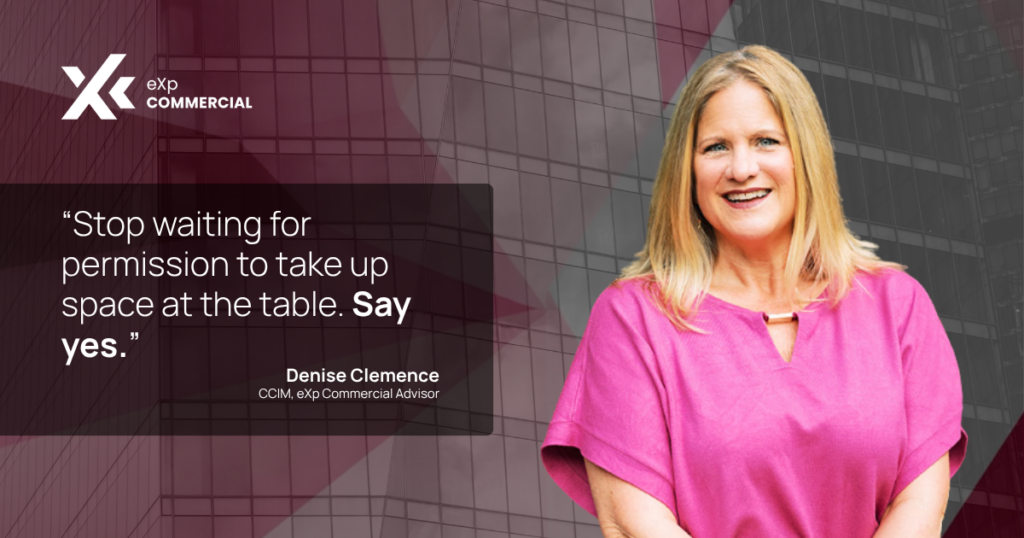
Denise Clemence: What 20 Years on the Lender’s Side of the Table Taught Her
Denise Clemence was this month’s guest. Her path into commercial real estate started at CoStar in the early 2000s, where she spent three years and developed a deep interest in the industry. Starting a family at the time, her mentor encouraged her toward SBA lending — a role that would keep her close to commercial real estate while offering more predictable hours. What followed was over two decades on the money side of the deal, where she oversaw the funding of more than $250 million across business acquisitions, startups, expansions, refinancing, and commercial property of most building types.
She earned her CCIM designation while still a lender. She served as CREW Tampa Bay president in 2008. She is the incoming president of the Florida West Coast district CCIM. Her formal education is in nursing, and she carries that into her work through the tagline, “Nursing people’s dreams versus their bodies.”
She had been watching eXp Commercial develop from the outside for years. Mroczkowski had invited her to an eXp event in Florida back in 2018, and Clemence drove home that night calling her best friend, “I don’t know what it is, but there’s something here.” She crossed the table and joined eXp Commercial last year. “I knew the moment I was going to go in that I was going to end up at eXp. Everybody said you’ve got to talk to this person and that person, and I did. But, I just kept coming back.”
What drew her wasn’t just the platform. It was that she didn’t have to choose. At traditional firms, the consistent message had been that she needed to pick a lane — one specialty in one market. At eXp, she could do commercial real estate, business brokerage, and retain the SBA expertise she’d spent two decades building. “I didn’t have to make the choices I was afraid of,” she said. “I was able to join a larger team with no boundaries.”
CCIM: The Designation That Changes the Conversation
Both Mroczkowski and Clemence hold the CCIM designation. Mroczkowski earned hers in 2015 and served as West Coast Florida district president in 2018, the same role Clemence is about to step into. Both described it not as a credential to put on a business card, but a framework that fundamentally changes how you think through a deal and how clients receive your advice.
“CCIM is a rigorous analytical framework for evaluating commercial real estate transactions,” Clemence told the group. “The education changed the conversation with clients from a gut discussion to evidence-based advising. It focuses on analysis and data, and it changes the trust dynamic with clients and with other agents. They know what you know.”
Mroczkowski added that she pursued it at 25, in part because she looked young and needed the credibility. Once she had it, she started receiving referrals from CCIM members across the country who trusted the designation as a signal of competence, something no amount of time in the business can replicate on its own. “Truly the best networking in the industry with the nicest people,” she said. “I’ve never met a CCIM who isn’t lovely to talk to, learn from, and expand your network with.”
Clemence is currently pursuing the Certified Business Intermediary (CBI) designation as well. “Education is the one investment you can make in yourself that nobody can ever steal.”
The Tool Belt: Why the Best Deals Take a Village
One of the clearest and most useful things Clemence put to the room was the concept she calls building your “tool belt” — a curated, intentional network of attorneys, CPAs, lenders, consultants, and specialists that she can reach for depending on what a deal requires. It sounds like standard networking advice until she illustrated it with a deal.
A Colorado client wanted to sell a large landscaping company to the owner’s sons. On paper it was a straightforward business transfer. In practice, it required an attorney for the stock purchase agreement (there is no standard form), a business consultant to document institutional knowledge and produce financial projections, a specialty lender to finance the fleet of vehicles separately from the building and business loan, and a 1031 exchange specialist to help the sellers manage tax implications on the real estate side. Clemence coordinated all of it.
“It takes a village to close a deal,” she said. “You’re not going to list it, sell it, close it, and finance it all yourself. Having those contacts is intentional.” The point she pressed was the more complex the deal, the more the tool belt matters, and the practitioners who wait until they need a specialist to start building those relationships are already behind.
“Somewhere in our minds we think it’s a weakness to ask for help. Really, it’s a signal of sophistication. Your clients don’t lose confidence — they gain it. Because you’re not just you. You’re that tool belt of all those people that surround you,” Clemence explained.
Mroczkowski reinforced it from her own practice, sharing that when a hotel listing comes across her desk, her first call is to the hotel specialist in her network. She splits the commission, closes the deal and learns the sector. “I would much rather split a commission, get a deal done, learn from it, and maybe next time do it myself. As much as you send out to others, you’re going to get more in return.”
Leading Before You Feel Ready
Mroczkowski’s final question to Clemence was the one that generated the most useful answer. “What advice would you give to women who want to become leaders in this industry — not just successful brokers, but respected leaders?”
Clemence didn’t hesitate. “Stop waiting for permission to take up space at the table. Say yes. Volunteer. Get on a committee. Start small, grow bigger.” She noted that most leaders, by their own account, don’t feel completely ready when they take the role. She includes herself in that. She’s about to become district president and still feels the same uncertainty she felt in 2007 preparing for the CREW presidency. “What makes the difference is we show up, we raise our hands, we do the work, and the results speak for themselves.”
The practical guidance she shared was to get involved in at least one industry organization, like CCIM, CREW, or something adjacent, and treat membership as a business strategy, not a line item. “When you step into membership and you step into leadership, you’re not filling a seat. You’re shaping the culture and your success.”
Takeaways from Session 3
- Build your tool belt before you need it — attorneys, CPAs, lenders, 1031 specialists and franchise consultants. Intentional relationship-building with specialists is infrastructure, not networking for its own sake.
- CCIM shifts the conversation from gut-feel to evidence-based advising; from being unknown to being trusted by other designees across the country.
- Asking for help is sophistication. Clients don’t lose confidence when you bring in an expert; they gain it because you’ve just expanded the team working on their problem.
- Leadership looks optional until it isn’t. Get on a committee, volunteer for a board, raise your hand before you feel fully ready. The results follow the action, not the other way around.
- Split the commission, close the deal, learn the sector. Bringing in the right partner for an unfamiliar property type is a long-term investment in capability, not a short-term loss of income
- Trust is built by listening, showing up on video, and following through. The practitioners who answer the phone and do what they said they’d do are already ahead
The Room Responds
The open conversation surfaced several threads that extended the session’s themes.
Leigh Brower, session two’s guest speaker and now a returning voice in the room, returned to the imposter syndrome discussion from her own session — this time as a testimony. “When I first came into the commercial space it was very scary,” she told the group. “I said to Brit, I’ve got imposter syndrome, how do I overcome this? And she was like — but you have experience, and so do I. So when I went in, I said, ‘me and my partner combined have over 20 years of experience together.’” That framing, she said, helped close the deal. “It works.”
Paul Frank, who coaches a roster of mentees spanning from an 18-year-old newly licensed agent to a group including five CCIMs, shared a revealing data point. When he ran a survey on confidence and professional satisfaction, the language his most inexperienced and most experienced mentees used was nearly identical. The gap between where they were and where they thought they should be was expressed the same way, regardless of tenure. “If you feel like an impostor, it appears everybody does,” he told the group. “Get that out of your head.”
Gaby Ballesteros, a former investment banker who joined eXp Commercial in March and closed over $10 million in volume in her first year in real estate, noted that dismissive behavior from established commercial agents is something women in this industry will encounter. “Those are the type of situations that make me push harder. Surround yourself with people that are humble, people that are going to support you, that are going to be okay with you asking questions.”
John LeTourneau, responding to a question about deal analysis, recommended attendees print an APOD form, walk through a building with the owner, write the numbers down, and demonstrate a return calculation on a phone calculator. “They will look at you like you’re a wizard and you did nothing more than addition, subtraction, and fundamentally basic math.”
How to Get Involved
Masterminds like this are rare in commercial real estate. That is the point and the gap Mroczkowski is deliberately closing.
She Does Deals is built for the conversations that don’t happen at all brokerages, such as where you made the mistake, what it cost, and who has been through the same one and come out the other side. The deal flow that follows from those connections is a byproduct. The relationships — advisors who become colleagues, mentors, and peers — are the product.
As of Session 3, the series is officially open to professionals outside eXp. Every advisor at eXp Commercial, every agent at eXp Realty, and anyone in or adjacent to commercial real estate with a story to share or a question worth asking.
The next session is July 29. Click here to join it.