For the better part of three years, the narrative surrounding the U.S. office sector has been singular and somber. The headlines have been dominated by rising vacancies, remote work adoption, and distress. However, economic data from the third quarter of 2025 suggests that the script is finally being rewritten.
According to the latest data from CoStar, we are witnessing what appears to be a critical inflection point. While risks persist and the road to full recovery remains long, the metrics indicate that the office market has moved from a state of freefall to one of stabilization — and in some key metros, genuine growth.
Here is an in-depth look at the current state of the market, the emerging winners, and what the data tells us about the road ahead.
The Demand Rebound
The headline number is impossible to ignore: in the third quarter of 2025, the U.S. office market recorded over 12 million square feet of positive net absorption.
To put that in perspective, more companies moved into office space than moved out. This is the first time we’ve seen meaningful positive growth since late 2021, and it represents the strongest quarterly occupancy gain since 2019.
But the quality of this demand is even more interesting than the quantity. For a long time, the industry focused on a “flight to quality,” assuming only brand-new, ultra-luxury buildings could attract tenants. That dynamic is shifting. For the first time in nearly four years (15 quarters), three- and four-star buildings saw positive absorption. Even more telling, buildings older than ten years recorded occupancy gains for the first time since 2018. This indicates that the recovery is broadening out; it is no longer exclusive to the newest skyscrapers.
The Supply Correction
Basic economics dictate that price and occupancy stabilize when supply meets demand. While demand is creeping up, supply is doing the rest of the work by shrinking significantly.
Construction activity has decelerated sharply. Through the first nine months of 2025, developers delivered only 8 million square feet of net new supply. Looking forward, the pipeline of office space currently under construction has fallen to 57.5 million square feet, marking its lowest level since 2011.
For investors and landlords, this is good news. With fewer cranes in the sky and less new inventory hitting the market for the next few years, existing buildings will face less competition, likely accelerating the backfilling of vacant spaces.
Geographic Winners: The Markets Bucking the Trend
Real estate is never a monolith; the “national average” hides the fact that some cities are thriving while others struggle. While cities like Chicago, Los Angeles, and Washington, D.C. are still searching for stability, other markets are actively outperforming.
Three clear winners have emerged in the 2025 landscape:
- New York City: The Big Apple is leading the national recovery. Driven by robust office attendance (hovering near 90% of pre-pandemic levels) and steady hiring in financial services, New York has posted six consecutive quarters of positive occupancy gains.
- Dallas-Fort Worth: Reflecting the broader economic shift toward the Sun Belt, Dallas continues to outperform the national average, buoyed by strong population and economic growth.
- Miami: Similar to New York, Miami is benefiting from high office attendance and a migration of capital. Alongside New York, it leads the nation in return-to-office metrics.
These markets prove that where the local economy is vibrant and commute friction is managed, the office remains a central hub of productivity.
Capital Markets: The Smart Money Returns
Perhaps the strongest vote of confidence comes from the capital markets. When institutional investors like the pension funds and major asset managers start buying, it usually signals they believe pricing has hit the bottom.
That is exactly what we are seeing. Sales volume in Q3 was nearly double what it was a year ago. Institutional players have re-entered the arena, spending approximately $6 billion year-to-date, a higher activity level than the previous two years. Notable transactions, such as the sale of the Americas Tower in Manhattan and large portfolio trades in the Sun Belt, suggest that investors believe the window to buy at “bottom-of-the-cycle” pricing is open.
The Outlook: Cautious Optimism
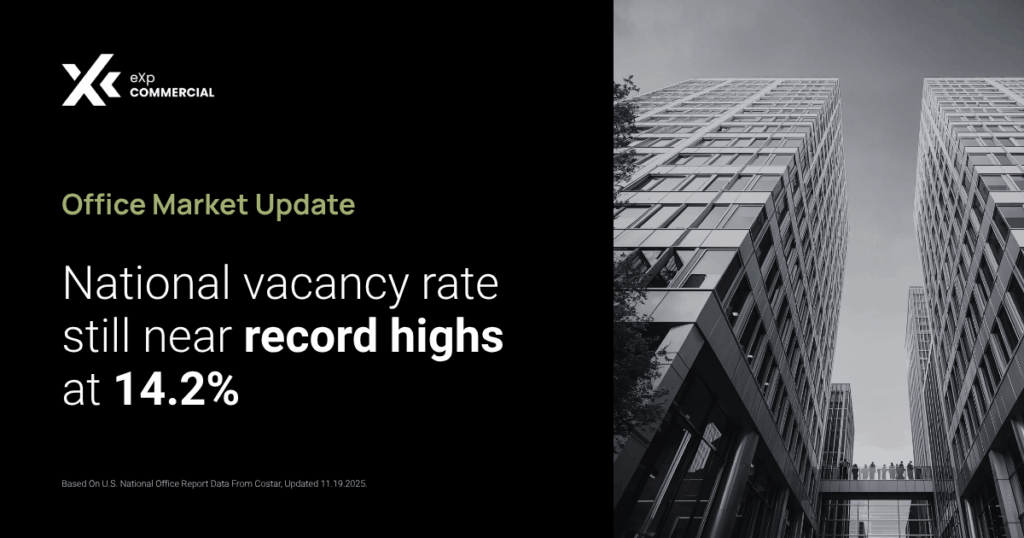
Despite these green shoots, we must remain realistic: the national vacancy rate is still hovering near record highs at 14.2%. Asking rents are largely stagnant, and concessions, such as free rent and tenant improvement allowances, remain high as landlords compete for deals. It will take years, not months, to fully absorb the surplus of space, and rent growth in average buildings will likely remain flat for the near future.
However, the paralyzing uncertainty of the last three years appears to be lifting. With demand broadening, construction slowing, and liquidity returning to the sales market, the U.S. office sector is moving from a state of crisis to a state of recovery.
Ready to learn more? Contact an eXp Commercial advisor today.
This article is for informational purposes only and should not be construed as financial advice or a solicitation to make investment decisions. Market data sourced from the CoStar United States Office National Report, November 19, 2025, licensed to eXp Commercial.